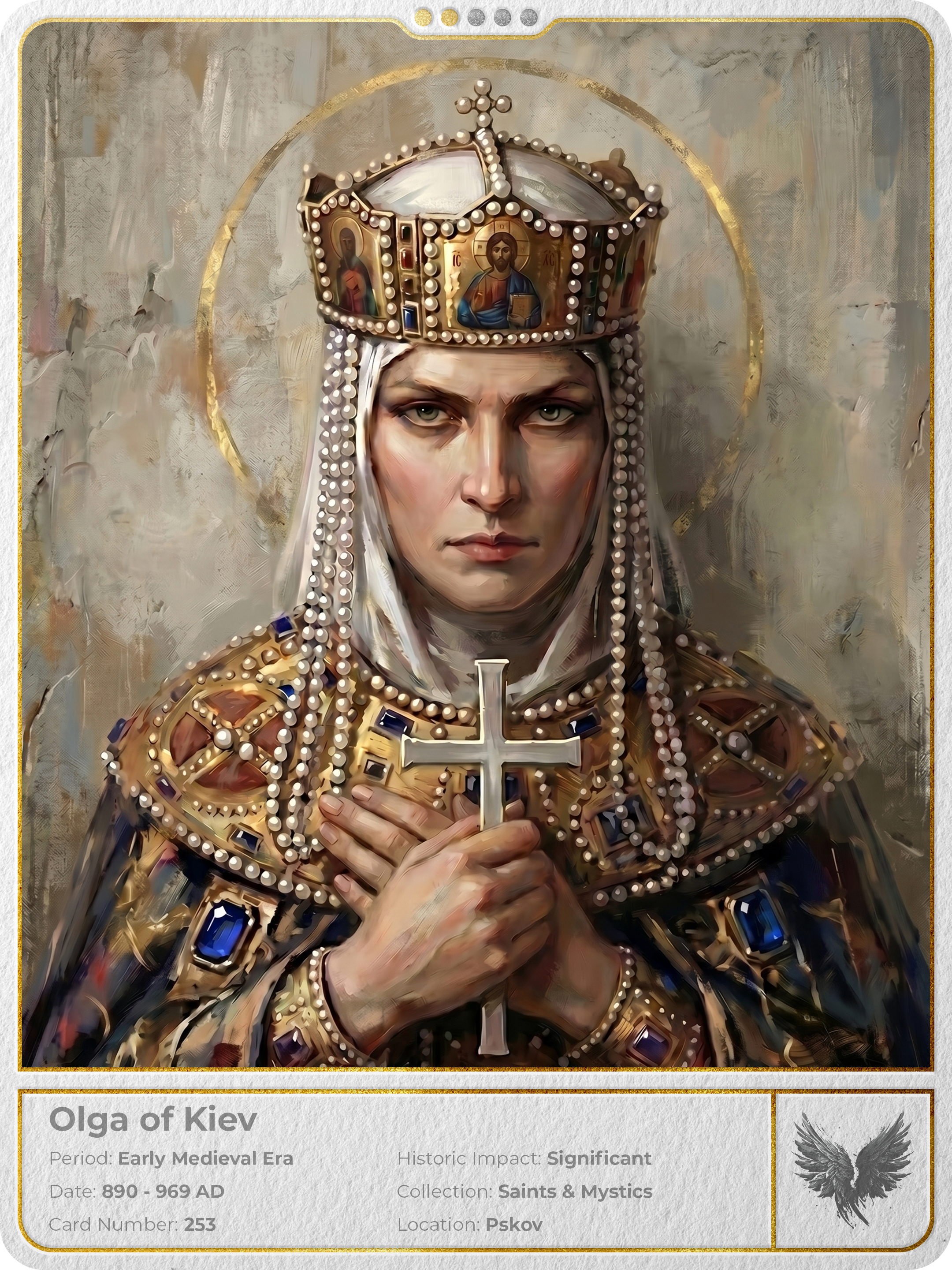
Window on a Warpath
One Widow. Four Revenges. Zero Mercy.
Few people in human history capture female fury as great as Olga of Kiev.
When the Drevlians eliminated her husband, they expected her grief but signed their own death warrant.
This is the story of a widow who went on a warpath and left a trail of complete devastation in her wake.
Act I: The Birch Trees
It is the year 945 AD.
The forests of what will one day become Ukraine stretch for hundreds of miles in every direction, dark, dense, ancient. Somewhere in those forests lives a tribe called the Drevlians. Their very name means the forest people. They are East Slavs, pagans, fierce and proud, with their own prince, their own capital city, and a long memory for grudges.
For decades they have paid tribute to the rulers of Kiev. They hate it. And in 945, when a Kievan prince named Igor rides into their territory to collect tribute for the second time in a single month, they decide they have had enough.
They seize him. They bend two birch trees to the ground and tie one of Igor’s legs to each tree. Then they let go.
Igor, Prince of Kiev, is torn in half.
Back in Kiev, a woman named Olga receives the news. She is a widow. Her son and heir, Sviatoslav, is three years old. The throne is fragile. The Drevlians know this, and they move quickly. They dispatch twenty of their finest men by boat to Kiev with a message: forget Igor. Their prince is named Mal. Olga should marry him instead. Together they will rule.
They expect a woman in mourning, but find something else entirely.
Act II: The Courtyard
Olga receives the Drevlian ambassadors with warmth. She listens to their proposal and tells them their words are pleasing to her. She asks them to return to their boats for the night. Tomorrow, she says, she will receive them with all the ceremony their status deserves. Her people will carry them through the city in their boats, as befits men of such importance.
The Drevlians are delighted. They return to their boats and wait.
During the night, Olga’s men dig a trench, wide and deep, in the courtyard of her palace.
In the morning, Olga’s servants go to the ambassadors and invite them to be carried to the princess in their boat. They are carried through Kiev and into the palace courtyard. It is here where they are dropped, boat and all, into the trench.
Olga appears above them. She asks if they find the honour to their liking.
Then she buries them alive.
She is not finished. Not remotely.
Act III: The Bathhouse
She sends word to the Drevlian homeland: she accepts the proposal, but it would not be right for her to arrive at Prince Mal’s court without a proper escort. Send your most distinguished noblemen to accompany her. She cannot come without them.
The Drevlians are pleased. They send their best.
When the delegation arrives in Kiev, Olga receives them graciously. She tells them they must be tired and dirty from the road. She has prepared a bathhouse for them — warm water, rest, refreshment. It is only proper.
The noblemen enter the bathhouse.
Olga’s men bar the doors and set the building on fire.
Two delegations gone, Kiev is still standing and Olga is still ruling.
Act IV: The Feast
She sends another message to the Drevlians. She is coming to mourn her husband at his grave. She asks them to prepare a great funeral feast, as custom demands. She will come with a small retinue. She wants only to weep over Igor and drink to his memory.
The Drevlians comply. The mead flows. The food is laid out. When Olga arrives, she sits beside her husband’s grave, and she weeps. The Drevlians eat and drink and begin to relax. Perhaps the widow has made her peace with things. Perhaps it is over.
When they are drunk, Olga gives the signal.
Her men move through the feast. The Primary Chronicle records that five thousand Drevlians die that night.
Still she is not done.
Act V: The Siege
The following year, Olga raises an army and marches on Iskorosten, the Drevlian capital — the city where Igor was killed. She lays siege. The city holds. Weeks pass. Months. A year. The walls do not break.
Then Olga sends a message into the city. She is tired of war, she says. She asks for a modest tribute. She does not want gold. She does not want slaves. She wants only three sparrows and three doves from each household.
The Drevlians cannot believe their luck. They gather the birds and send them out.
That night, Olga’s soldiers tie small pieces of sulfur-soaked cloth to the leg of each bird. They light the cloth. They release the birds just outside the walls.
The birds fly home to their nests into the rafters of every house in Iskorosten.
The Primary Chronicle records what happens next: there was not a house that was not consumed, and it was impossible to extinguish the flames, because all the houses caught fire at once.
As the citizens pour out of the burning city, Olga’s army is waiting.
Iskorosten falls. The Drevlians as a people are finished, eliminated, enslaved, or absorbed into Kievan rule. The last time the chronicles mention them as a distinct people is 1136. Nearly two centuries after Olga, they simply cease to exist.
Act VI: The Conversion
Olga does not disappear into history as a warlord but rules as regent for her son Sviatoslav for the next thirteen years. She reorganizes the entire tribute system of Kievan Rus, establishing fixed rates and collection points across the realm. Historians consider it the first legal reform in Eastern European history.
She travels to Constantinople where she converts to Christianity. She becomes, in time, the first ruler of Kievan Rus to do so.
In 1547, nearly six hundred years after her death, the Russian Orthodox Church canonizes her as a saint. Equal to the Apostles, they call her. Patron saint of widows and converts.
She faced annihilation, answered it with fury, and then built something that outlasted her by centuries. Six hundred years later the Drevlians are forgotten, their prince Mal is a footnote, their city Iskorosten is ash and legend.
Olga of Kiev became a saint.
You can browse the physical decks here.


