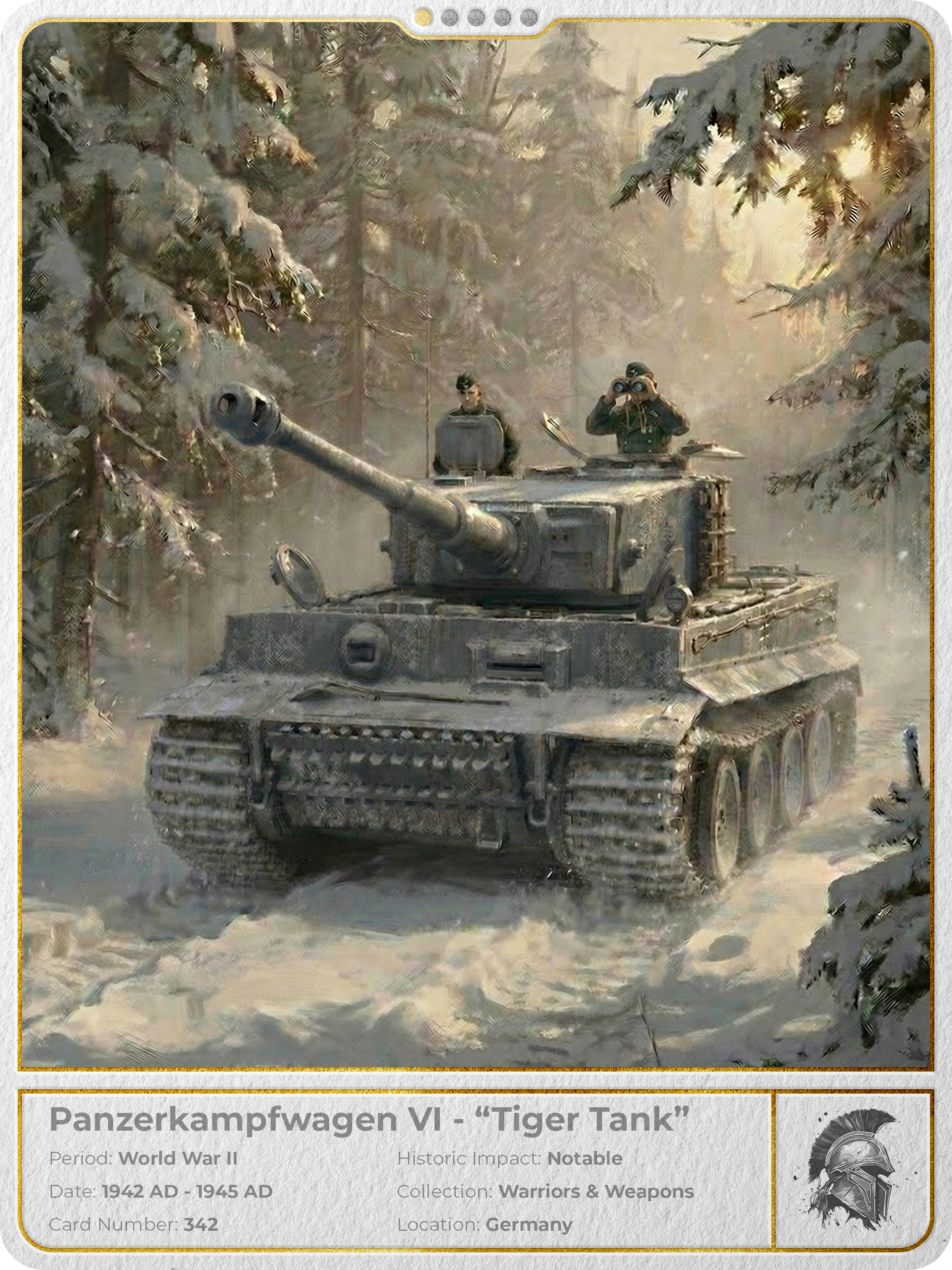
The Perfect Weapon That Lost
Why the Tiger Tank couldn't win the war it dominated.
Growing up watching Band of Brothers, Saving Private Ryan and playing games such as Medal of Honor, there is one tank that haunted every battlefield. It didn’t need to fire a shot to change the course of a scene. Just its silhouette on the horizon was enough to make everyone stop. I was maybe twelve years old when I first saw one on screen and realized it meant trouble.
At the time it probably was the menacing squarish shape, and the deep rumbling of its Maybach engine. But now, decades later, I understand the deeper reasons why.
The Tiger I (or Panzerkampfwagen VI) made its combat debut in September 1942 near Leningrad. German engineers had spent years designing a tank that could dominate any battlefield, and they succeeded beyond anyone’s expectations. An 88mm gun derived from a Flak 36 anti-aircraft cannon. A hundred millimeters of frontal armor. A machine so formidable that the standard Allied tank of the time, the American M4 Sherman, could not penetrate its front at any range whatsoever. To even scratch the side armor, a Sherman crew had to close to within a hundred meters. Close enough to see the German commander’s face.
Allied tank crews were given unofficial but very real advice: never engage a Tiger from the front. The only chance was to flank it, find the weaker side armor, and pray you got there before it spotted you. That advice tells you everything about how the balance of power felt in those early years.
But the Tiger’s impact went beyond the mechanical. It got inside people’s heads. Allied commanders reported soldiers refusing to advance when a Tiger was merely suspected in the area. A single tank could pin down an entire company just by existing. I understand now how a single machine could make grown men freeze before it even fired a shot.
Germany’s answer to Allied numerical superiority was technological superiority. One Tiger was expected to do the work of five Shermans. On paper, the kill ratios proved them right. In reality, it created a strategic trap Germany never escaped.
The Tiger weighed 57 tonnes. It broke pontoon bridges, sank in soft ground, and couldn’t be transported by rail without removing its wide battle tracks first. It required roughly ten hours of maintenance for every hour of combat. Skilled mechanics were always scarce, spare parts were always delayed, and more Tigers were ultimately lost to mechanical failure than to enemy fire. Germany had built a masterpiece it couldn’t afford to keep running.
British engineers got hold of an intact Tiger in North Africa in early 1943 and spent weeks tearing it apart. What they found changed everything. The frontal armor was a hundred millimeters thick. The top armor was just 25mm. The same machine that laughed at tank shells could be cracked open from above like an egg. Allied tacticians built entire air attack strategies around that number.
On the ground, the British mounted a 17-pounder gun onto the Sherman chassis and created the Firefly, suddenly giving Allied tankers a weapon that could punch through Tiger armor at realistic combat distances. German crews responded by targeting Fireflies first, which told you exactly how much that development worried them.
The Soviet Union took an entirely different approach. Rather than building a better tank, they built more tanks. The T-34 was faster, simpler, and could be produced in staggering numbers. Soviet factories churned out thousands while German factories struggled to build hundreds. It was a different philosophy of war, and by 1944 it was clearly winning.
By the final year of the war the Tiger’s dominance was fading. But it wasn’t just other tanks that broke it. It was everything at once. The P-47 Thunderbolt (of which I’ll make a Card soon) and British Typhoon hunted Tigers from above, exploiting that thin 25mm roof. Artillery barrages fixed Tiger units in place while flanking forces moved around them. Infantry with anti-tank weapons, air spotters calling in strikes, tank destroyers probing the flanks. No single weapon beat the Tiger. The Allies built a system that overwhelmed it from every direction simultaneously.
That is the part that gets lost in the Hollywood version. It wasn’t one heroic tank (commander) that finally took the Tiger down. It was coordination, logistics, and industrial scale applied as a weapon in itself.
The final numbers tell the whole story. Germany produced 1,347 Tiger I tanks during the entire war. The Soviet Union produced over 57,000 T-34s. The United States built nearly 49,000 Shermans. The Tiger won almost every one-on-one engagement it fought. It just couldn’t be everywhere at once.
The Tiger didn’t lose because it was outfought but because Germany ran out of fuel, factories, and men to keep it running. By then, that industry was collapsing from every direction. The lesson? A weapon is only as powerful as the industry behind it, this is true in the Ukraine conflict as it was during the second World War.
So as a final takeaway: the most fearsome tank of World War II was defeated not by a better tank, but by spreadsheets, factories, and logistics. The Allies out-produced, out-supplied, and out-lasted it.
1,347 masterpieces, defeated not by a better weapon, but by a better system.
As the saying goes, “Quantity has a quality of its own.”
Thanks for sticking with me. I’d be honored to have you follow my journey.


