

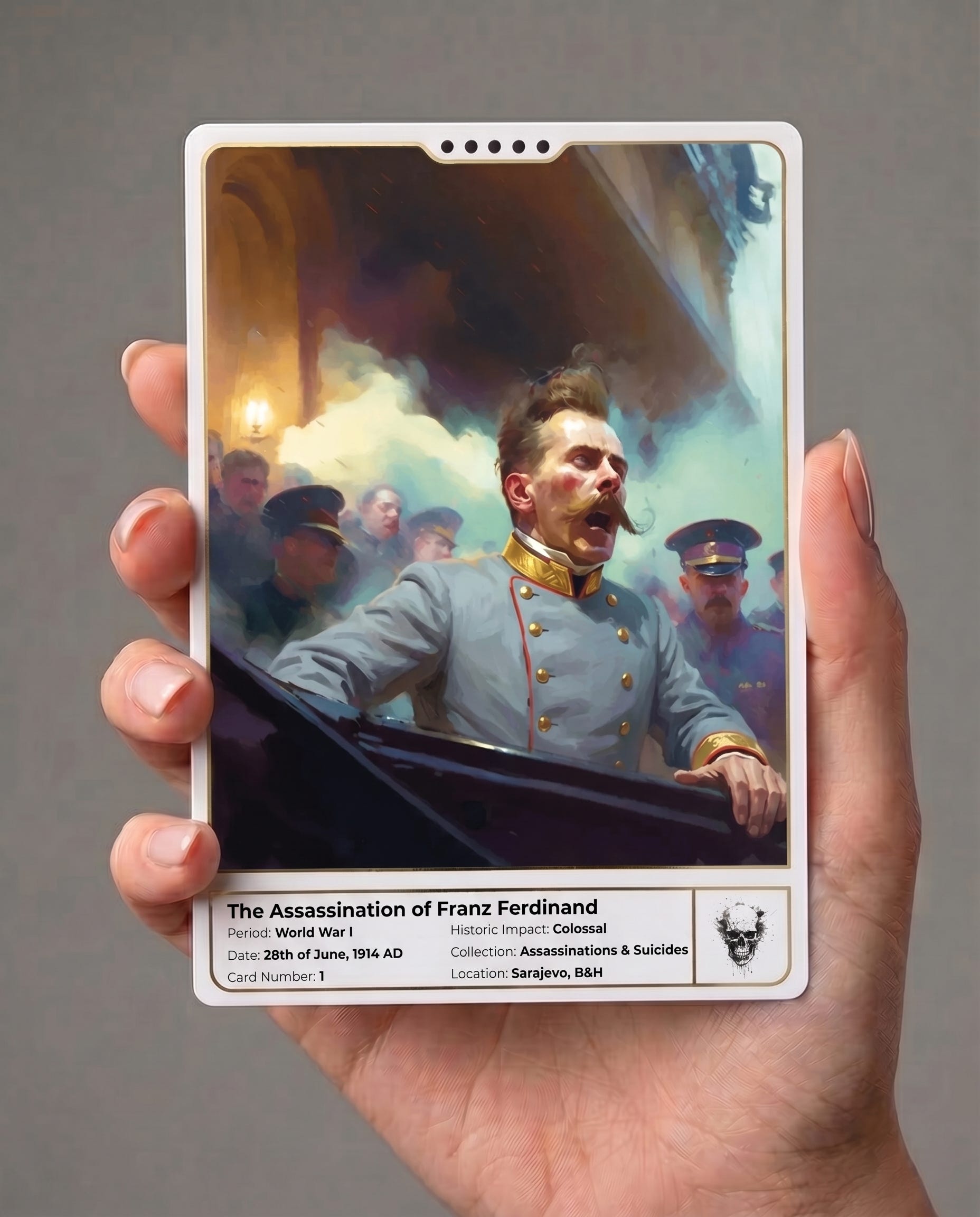
Have you ever seen the cult film Final Destination? The plot is simple. A teenager boarding a school flight has a vivid premonition that the plane will explode, panics, and gets himself and a handful of classmates thrown off before takeoff. Minutes later the plane blows up exactly as he saw it. The survivors believe they have cheated death. Death disagrees, and one by one it collects them through absurd chains of small accidents.
I kept thinking of that film while researching this piece. On the morning of 28 June 1914, Archduke Franz Ferdinand survived the attack that should have killed him. A bomb bounced off his car and exploded under the next one, he gave his speech at the town hall, and his route was changed to keep him safe. Then the small accidents began to line up: a message that never reached his driver, a turn taken out of habit, a gearbox that would not go into reverse, and a nineteen-year-old with a pistol who had wandered to that very corner to contemplate his failures.
Sunday, 28 June 1914, began hot and bright in Sarajevo. Flags hung from the windows along the Appel Quay, the broad embankment that ran beside the shallow Miljacka river, and crowds had gathered to watch the motorcade pass. Somewhere among them, spaced out along the route like fence posts, stood seven men carrying bombs and pistols. Most of them were teenagers.
By half past eleven that morning, Archduke Franz Ferdinand of Austria and his wife Sophie were dead. Within five weeks Austria-Hungary was at war with Serbia, and within six the great powers of Europe had followed. The war that came out of that morning killed something like twenty million people and dissolved four empires.
What makes Sarajevo so haunting is how close it came to failing. The plot was amateurish, the first attack missed, and the assassins mostly lost their nerve as the cars went by.
The Unlucky Heir
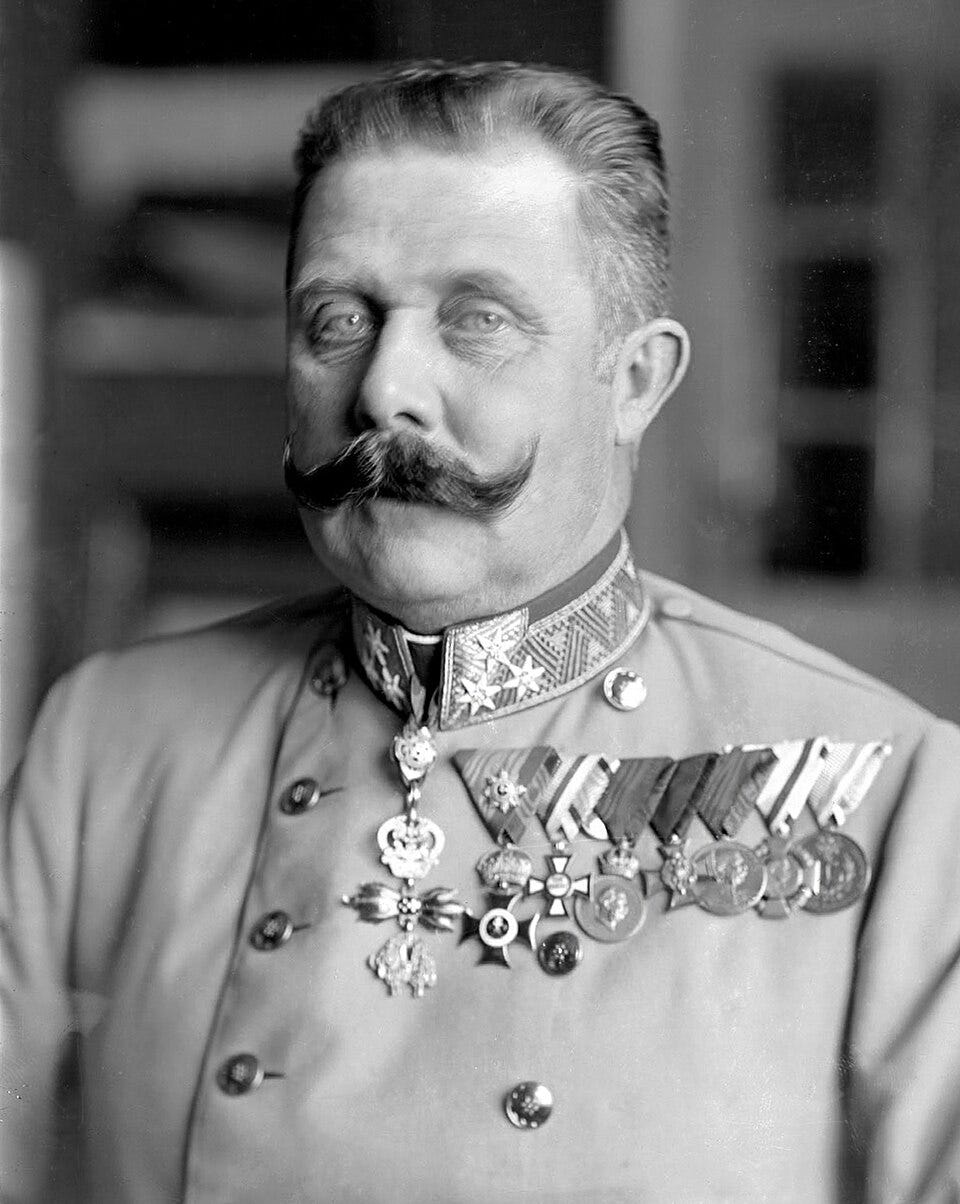
Franz Ferdinand was fifty years old, heavy, short-tempered, and widely disliked at the Viennese court. He had become heir to the Habsburg throne by accident, after the suicide of Crown Prince Rudolf at Mayerling in 1889 and the death of his own father in 1896. His uncle, Emperor Franz Joseph, had reigned since 1848 and never warmed to him.
The deepest source of friction for his family was his marriage. In 1900 Franz Ferdinand wed Countess Sophie Chotek, a Czech noblewoman of old family who nonetheless fell short of the rank Habsburg house law demanded of an imperial bride. The emperor allowed the match only as a morganatic marriage. Sophie could never be empress, and their three children were barred from the succession. At court ceremonies she walked behind the youngest archduchess and was kept from her husband’s side at public functions.
There was one exception. When Franz Ferdinand acted in his military capacity, as inspector general of the armed forces, his wife could share his honors. The historian A. J. P. Taylor drew the obvious conclusion: an inspection of the army in Bosnia offered the couple a rare chance to ride through a city together, side by side, in public. In Taylor’s telling, the archduke went to his death for love. Their son Maximilian later said that Sophie came along out of fear for her husband’s safety.
The emperor had ordered the archduke to attend summer maneuvers in Bosnia, which Austria-Hungary had occupied since 1878 and formally annexed in 1908. The annexation enraged Serbian nationalists, who regarded Bosnia’s large Serb population as their own. The date of the visit made matters worse. 28 June was Vidovdan, the feast of St. Vitus, on which Serbs commemorate the Battle of Kosovo in 1389. According to legend, a Serbian knight named Miloš Obilić slipped into the Ottoman camp that day and killed Sultan Murad I in his tent.
Franz Ferdinand himself was no enemy of the Slavs. He was widely believed to favor reorganizing the empire to give its Slavic peoples more weight, perhaps as a third crown alongside Austria and Hungary. That made him more dangerous to the nationalists, since a contented Slav population inside the empire would have little reason to look to Belgrade. Gavrilo Princip later told the court that stopping those reforms was one of his motives.
Seven Men on the Appel Quay
The men waiting along the river belonged to a loose movement of radical students later called Young Bosnia. They wanted Bosnia free of Habsburg rule and joined to the other South Slav peoples in a single state. All of them were Austro-Hungarian subjects. None came from Serbia itself.
The central figure was Gavrilo Princip, the son of poor Bosnian Serb farmers, slight and serious, nineteen years old. His friend Nedeljko Čabrinović, a typesetter, was the same age. In the spring of 1914 the two were living in Belgrade when they learned from the newspapers that the archduke would visit Sarajevo in June. With a third friend, Trifko Grabež, they resolved to kill him.
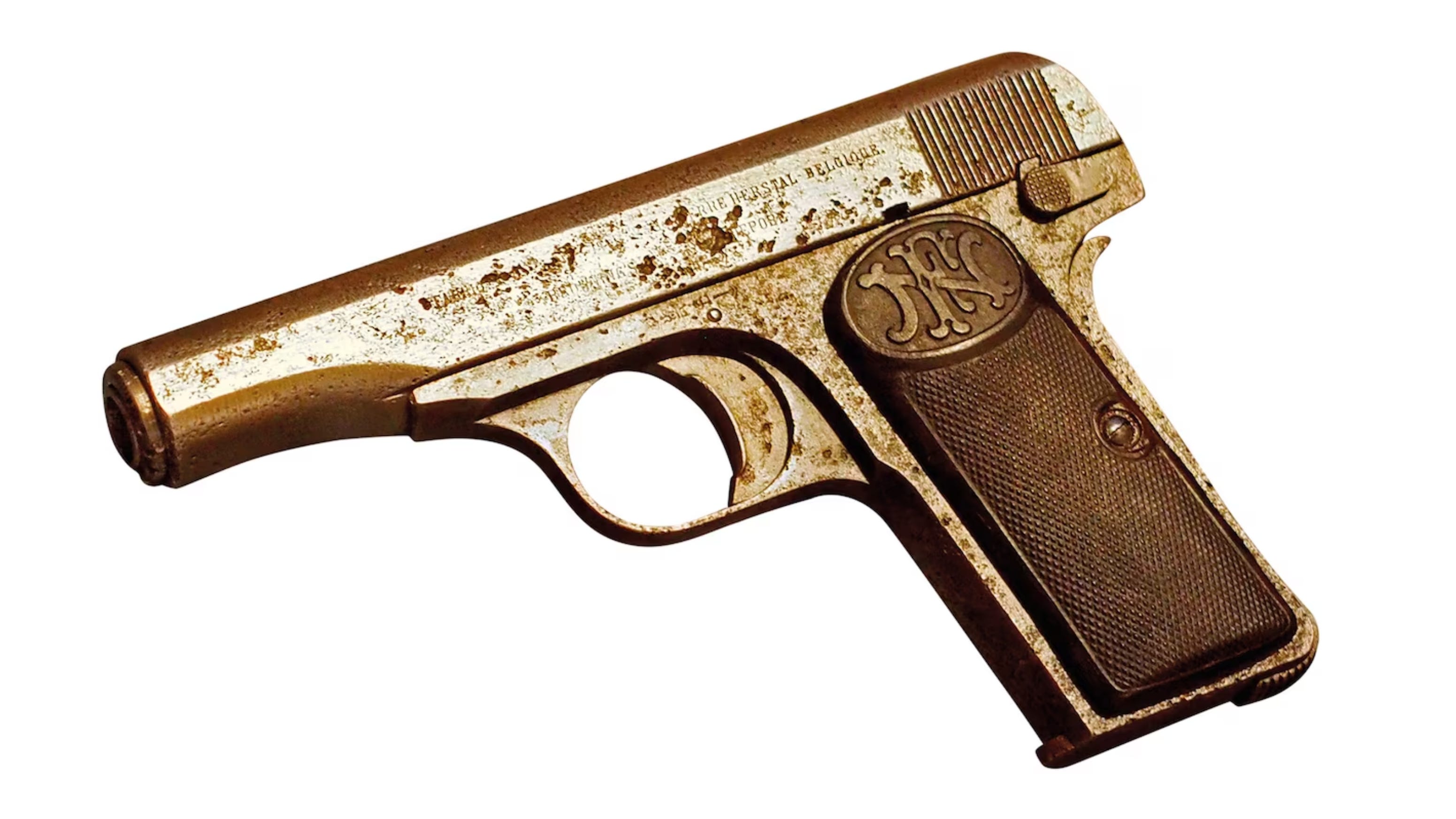
Idealism alone could not supply weapons. Through a well-connected Bosnian named Milan Ciganović, the students reached Major Vojislav Tankosić of the Serbian army. Tankosić gave them six hand grenades, four Belgian-made FN Model 1910 pistols, cyanide capsules for use after the deed, and some target practice in a park outside Belgrade. He belonged to the Black Hand, a secret society of Serbian officers, and he answered to its leading figure, Colonel Dragutin Dimitrijević, known as Apis, who was also chief of Serbian military intelligence.
How far Apis directed the plot remains debated. In 1917, facing a firing squad on unrelated charges, he claimed to have ordered it, though he may have exaggerated his role in hope of saving himself. What is clear is that a clandestine network of Serbian agents smuggled Princip, Grabež, and their weapons across the Drina river into Bosnia at the start of June, passing them from safe house to safe house. Serbia’s prime minister, Nikola Pašić, appears to have learned of the crossing and sent Vienna only a vague warning.
In Sarajevo the three joined a local organizer, Danilo Ilić, a former schoolteacher who had recruited three more: two schoolboys, Vaso Čubrilović and Cvjetko Popović, aged seventeen and eighteen, and Muhamed Mehmedbašić, a carpenter in his twenties. On the morning of 28 June, Ilić placed them along the Appel Quay and walked up and down the street urging them to be brave.
The Bomb That Missed
The imperial party arrived by train from the spa town of Ilidža, where they had been staying, and climbed into a line of six cars. Franz Ferdinand and Sophie rode in the third, an open Gräf & Stift tourer with its top folded down, together with the governor of Bosnia, General Oskar Potiorek, and the car’s owner, Count Franz von Harrach. Security was thin. The local army commander had offered to line the route with troops and was told this would insult the loyal population. Roughly sixty policemen were on duty for the whole city.
The motorcade passed Mehmedbašić first. He did nothing. Čubrilović, standing near him with a pistol and a bomb, did nothing either. A little farther on, on the river side of the quay, stood Čabrinović. At about ten past ten he knocked the cap off his bomb against a lamppost and threw it at the archduke’s car.
The bomb had a delay of several seconds. It struck the folded roof, bounced into the road, and exploded under the following car, blowing a crater in the street and wounding somewhere between sixteen and twenty people, including Potiorek’s aide, Lieutenant Colonel Erik von Merizzi. Čabrinović swallowed his cyanide and leapt over the parapet into the Miljacka. The poison was old and only made him vomit, and in that dry summer the river was a few inches deep. Police dragged him out, and the crowd beat him before he was taken away.
The motorcade sped on toward the town hall. Popović, Grabež, and Princip watched it race past and did not act.
At the town hall the mayor, Fehim Čurčić, began his prepared speech of welcome as though nothing had happened. Franz Ferdinand cut him off. He had come on a visit, he said, and been greeted with bombs, and it was outrageous. Sophie murmured something to him, and after a moment he told the mayor he might continue. When his own turn came he read from a speech that had been in the damaged car and was spotted with blood, adding a few words thanking the people of Sarajevo for their joy at the failure of the attack.
The Wrong Turn
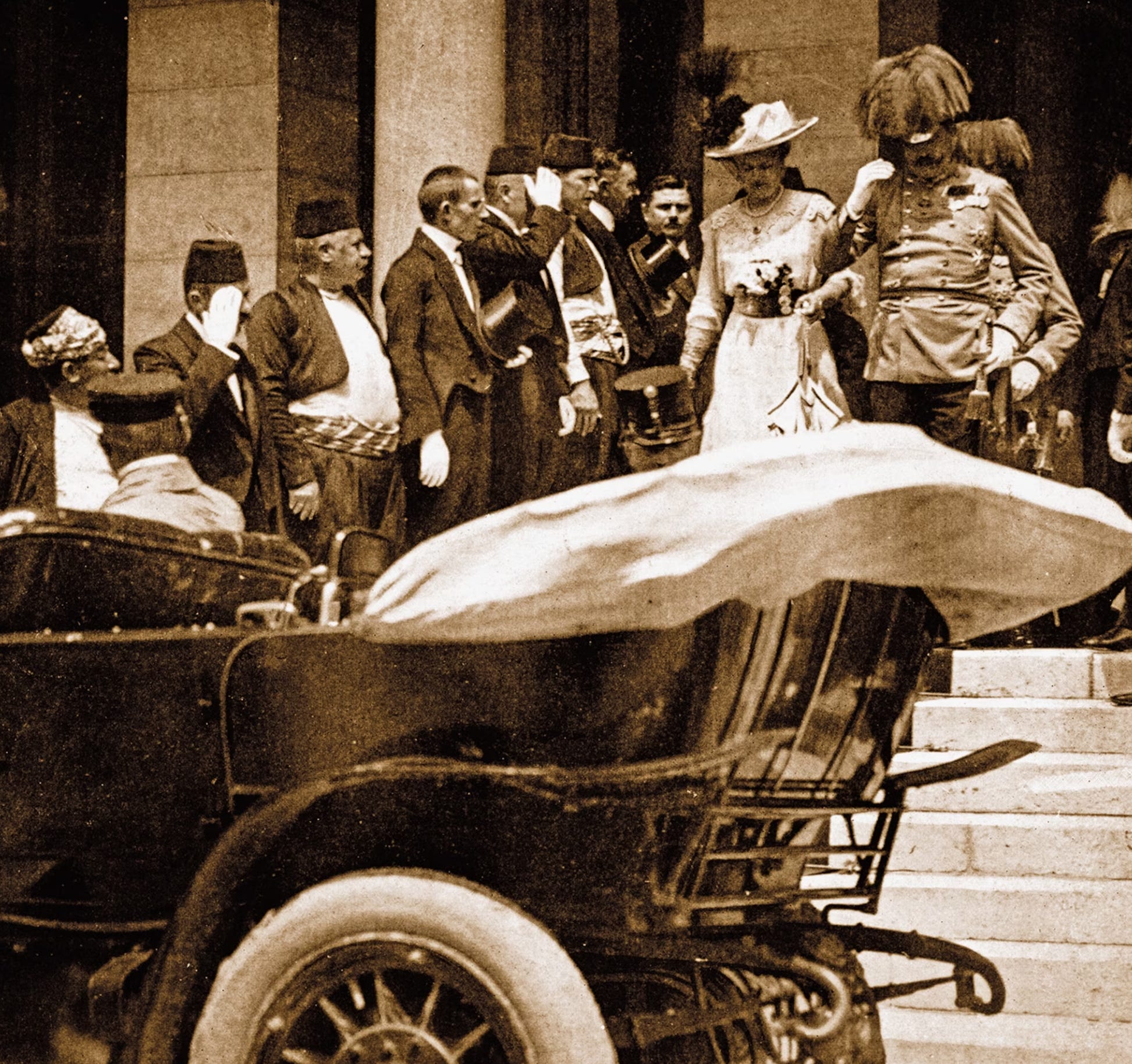
Inside the town hall, the archduke’s staff argued over what to do next. His chamberlain, Baron Rumerskirch, proposed that the couple wait until troops could be brought in to line the streets. Potiorek refused, objecting that soldiers fresh from maneuvers lacked proper dress uniforms. He is said to have asked whether anyone thought Sarajevo was full of assassins.
Franz Ferdinand decided to drop the rest of the day’s program and visit the wounded Merizzi in the garrison hospital. Sophie insisted on coming with him. To keep clear of the narrow streets of the old town, Potiorek ruled that the cars should drive straight back along the Appel Quay at speed. Count Harrach stood on the left running board of the archduke’s car, on the river side, to shield him from another bomb thrown from the embankment.
Nobody told the drivers. The officer who would normally have passed on such instructions was Merizzi, now lying in hospital. The Sarajevo police chief was asked to inform them and, in the confusion, failed to do so. So at about 10:45 the motorcade set off on the original plan, which called for a right turn at the Latin Bridge into Franz Joseph Street, toward the national museum.
The first two cars made the turn. The archduke’s driver, Leopold Lojka, followed them. Potiorek, sitting beside the couple, shouted that they were going the wrong way and should be on the quay. Lojka braked to a stop and tried to shift into reverse. The car stalled, or crawled to a halt while he fought the gears, and for a few seconds it sat almost motionless at the corner.
On that corner, outside Moritz Schiller’s delicatessen, stood Gavrilo Princip. After the failed bomb he had drifted to this spot. Popular legend says he stopped in for a sandwich, though no source from the time mentions it. Whatever he expected, he can hardly have expected this: the car carrying his targets shuddering to a halt a few feet in front of him.
Two Shots
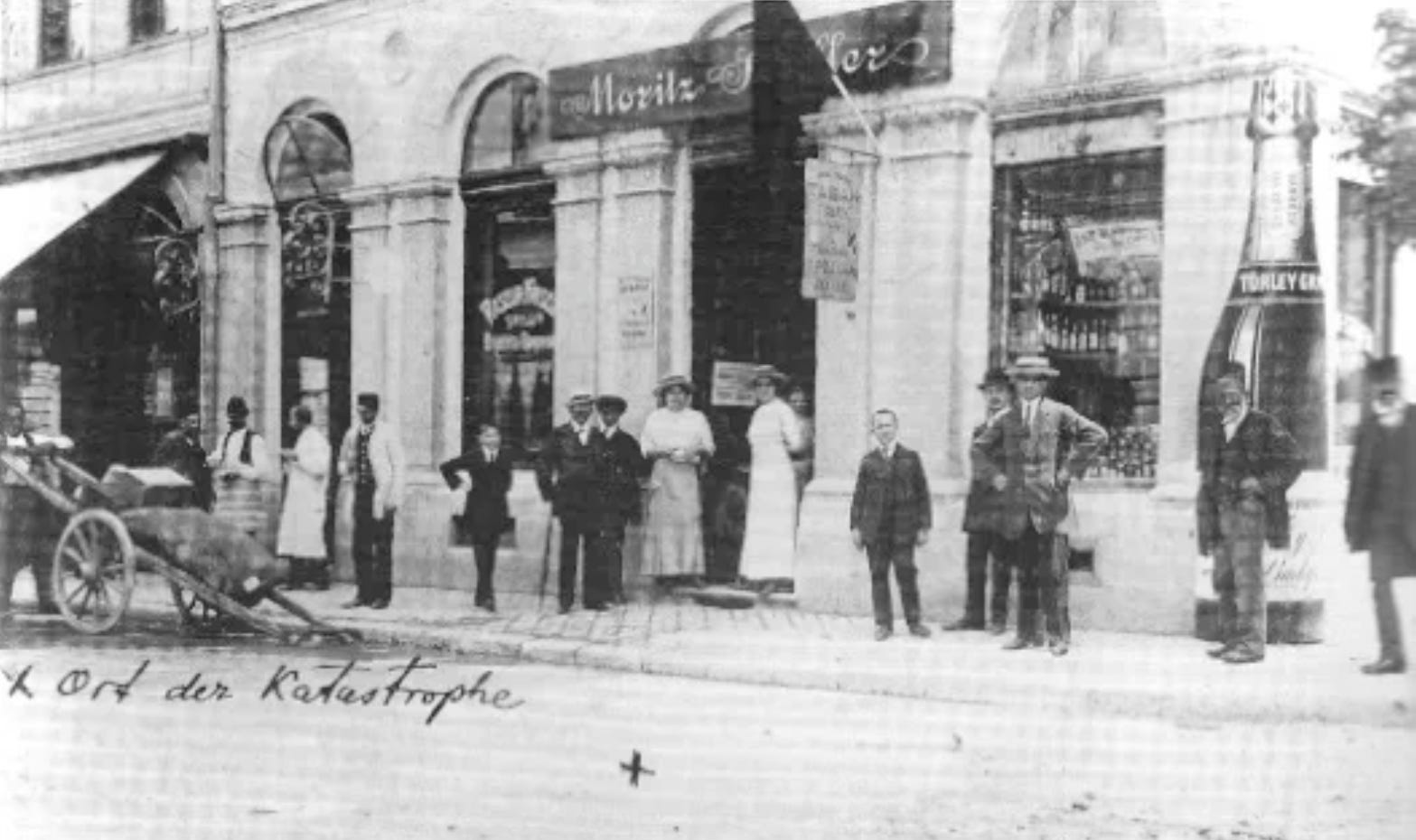
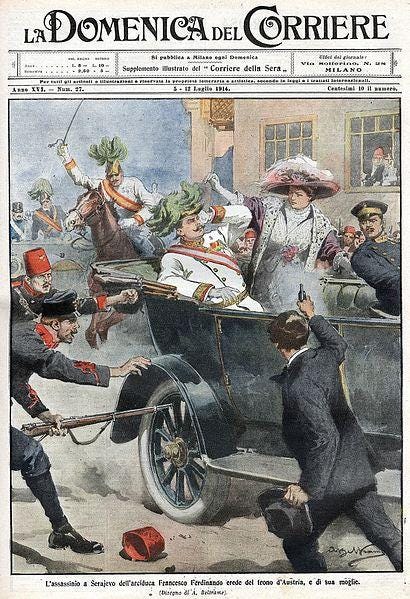
Princip stepped forward, drew his pistol, and fired twice from about five feet away. He later said he could not say exactly where he had aimed. The first bullet struck Franz Ferdinand in the neck, near the jugular vein. The second passed through the side of the car and hit Sophie in the abdomen. At his trial Princip said the second shot had been meant for Potiorek, and that he had never intended to kill the duchess.
For a moment nobody in the car seemed to understand what had happened. The couple sat upright. Then blood began to run from the archduke’s mouth, and Sophie slumped across his lap. Princip turned the pistol on himself and was seized before he could fire. He tried his cyanide, which failed him as it had failed Čabrinović, and the crowd fell on him.
Lojka got the car moving and drove across the Latin Bridge toward the governor’s residence. Count Harrach, holding the archduke upright, later gave the account of his last words. Franz Ferdinand begged his wife not to die, but to live for their children. When Harrach asked whether he was in great pain, he answered six or seven times that it was nothing, each time more faintly, until he could no longer speak.
Sophie was dead when they reached the residence. Franz Ferdinand died a few minutes later, at about 11:30, on a chaise longue in the governor’s rooms. The date carried a private weight for the couple: on 28 June 1900 he had sworn the oath renouncing the throne for any children of his marriage to Sophie.
One Month to War
The dead couple were treated with a coldness that shocked even their critics. The court official in charge of the funeral, Prince Montenuovo, had long resented Sophie, and with the emperor’s acquiescence he kept the ceremonies small. Foreign royalty were told not to come. Sophie’s coffin was placed lower than her husband’s, with a pair of white gloves on it, the mark of a lady-in-waiting. Barred from the imperial crypt in Vienna, she was buried with Franz Ferdinand at their castle of Artstetten, as he had arranged. The old emperor confided to his daughter that the death had relieved him of a great worry.
Vienna nonetheless treated the murder as a reason to settle accounts with Serbia. After securing a promise of German support, Austria-Hungary sent Belgrade an ultimatum on 23 July, with demands written to be hard to accept, including that Austrian officials take part in the Serbian inquiry. Serbia accepted most of the terms, evaded others, and refused that one. Austria-Hungary declared war on 28 July, one month to the day after the shots at the Latin Bridge. Russia mobilized to protect Serbia, Germany declared war on Russia and France, and Britain entered on 4 August after German troops crossed into Belgium.
The assassins were tried in Sarajevo that October. Because Princip, Čabrinović, and Grabež had been under twenty at the time of the crime, Austrian law spared them the gallows, and each received twenty years. Danilo Ilić and two of the men who had smuggled the weapons were hanged in February 1915. Mehmedbašić escaped to Montenegro and lived until 1943. Čabrinović expressed remorse at the trial and is said to have received a letter of forgiveness from the three orphaned Hohenberg children. He died of tuberculosis in prison in January 1916.
Princip died of the same disease in the fortress prison of Theresienstadt on 28 April 1918, a few months before the empire he had struck at fell apart. The infection had cost him an arm, and by the end he weighed around forty kilograms. He never stopped insisting that he had acted for the freedom of the South Slavs, and in 1916 he told a prison psychiatrist that the war would have come even without Sarajevo. Years later, Vaso Čubrilović, the schoolboy who had stood on the quay that morning and done nothing, lived to become a professor and a minister in Yugoslavia. Looking back, he said that they had destroyed a beautiful world that was lost forever in the war that came after.
Death’s Design
In Final Destination, the survivors spend the film trying to read Death’s design, convinced that if they can see the pattern, they can step out of it. Sarajevo invites the same game. With a shorter fuse, Čabrinović’s bomb would have killed the archduke on the quay and Princip would have gone home. Had Merizzi ridden in another car, he would have briefed the drivers. Had Lojka been told about the new route, or had the Gräf & Stift found reverse a second sooner, the car would have rolled past Schiller’s corner and on to the hospital.
Nobody wrote that script. Each link in the chain was an ordinary human lapse: a governor who refused to bring in troops, an order that never reached the drivers, a police chief overwhelmed by the moment, a chauffeur following the car in front. None of these men could have guessed that a mistake about a street corner would help decide the fate of a continent.
The film’s darkest idea may still apply. In Final Destination, escaping the plane crash only postpones the inevitable. Many historians suspect Europe in 1914 was in a similar position: an armed continent bound by rigid alliances and mobilization timetables, waiting for a crisis it could not talk its way out of. If the car had found reverse, war might have come a year or two later over something else. As it was, the appointment was kept on a Sarajevo street corner by a nineteen-year-old who had already let his target pass once that morning.
Sources
Vladimir Dedijer, The Road to Sarajevo (1966)
Luigi Albertini, The Origins of the War of 1914 (1952–57)
Christopher Clark, The Sleepwalkers (2012); Margaret MacMillan, The War That Ended Peace (2013)
Curious about the physical cards? Take a look at the full collection here.
Well done. Thanks for writing. I too marvel about the butterfly effect surrounding this event…