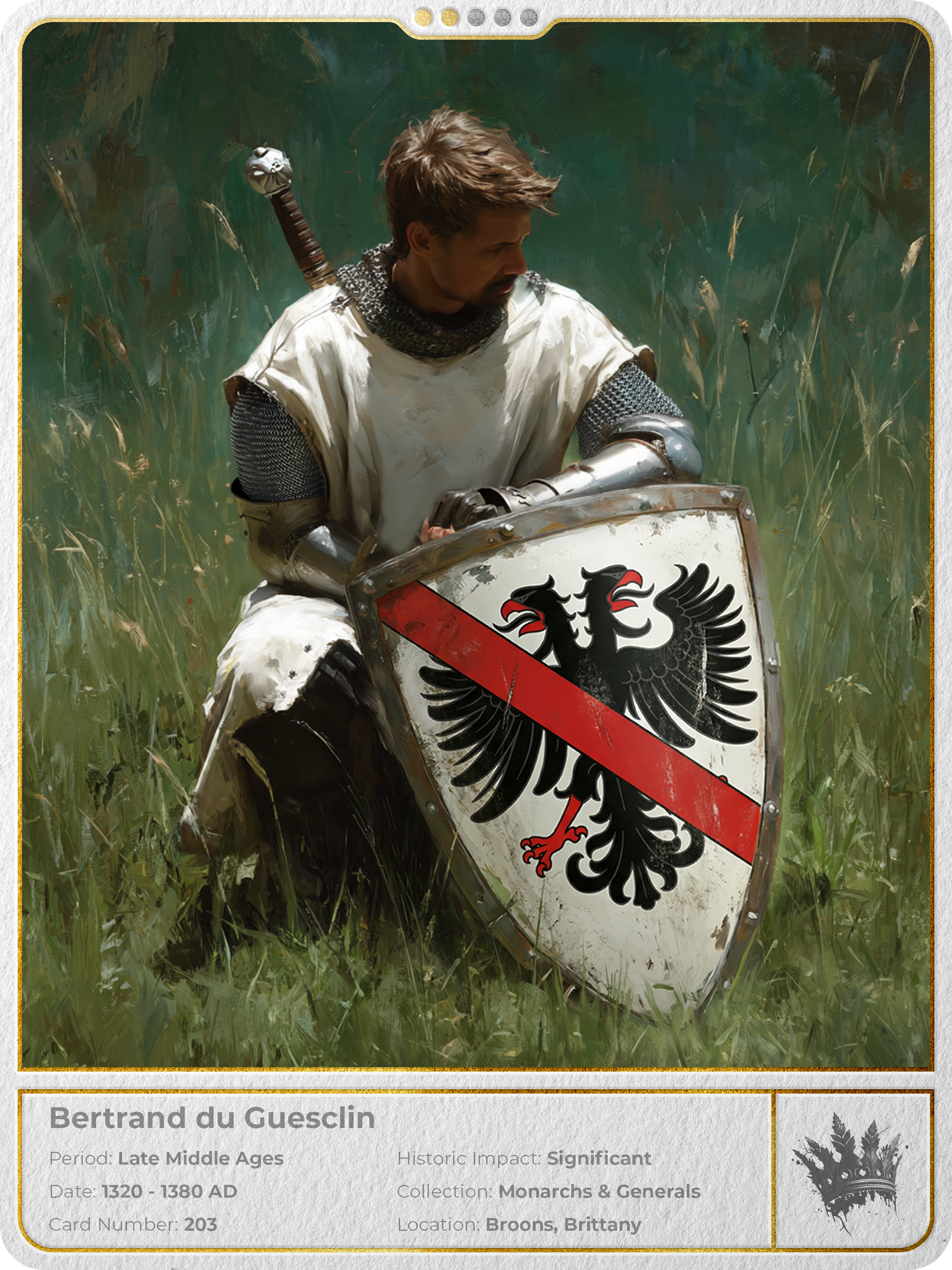
An Unlikely Hero: The Black Dog of Brocéliande
The story of an unconventional warfighter in the Age of Chivalry
During the darkest years of the Hundred Years’ War, France stood on the brink of collapse. Its armies were defeated, its ideals applied to warfare exposed as outdated, and its future uncertain.
From this chaos emerged an unlikely figure: Bertrand du Guesclin, known to his enemies as the Black Dog of Brocéliande. The name marked him as a rough forest fighter, far removed from the ideals of knightly romance. Over time, it came to signify grit.
This article explores how contempt forged strength, why France survived because it embraced necessity over illusion, and what du Guesclin teaches us about heroism when survival matters more than chivalric glory.
I. France at the Edge of Collapse
The Hundred Years’ War was not a single uninterrupted struggle but a century of invasions, fragile truces, betrayals, and renewed fighting. By the middle of the fourteenth century, France was exhausted. English armies controlled large territories. French forces had suffered devastating defeats.
King Jean II was captured, nobles argued among themselves, and faith in traditional warfare was crumbling. The proud image of mounted knights charging across open fields had failed again and again, each failure paid for in blood and land. The Battle of Poitiers exposed the bankruptcy of aristocratic glory as a military strategy. It showed that courage and status albeit important, were no longer enough.
This was a moment when reality forced a reckoning. France could cling to old ideals and continue to lose, or it could adapt. Yet adaptation demanded humility. It required admitting that the stories people loved no longer matched the world they lived in. Many nobles resisted this truth. They still believed victory would come through honor displayed in battle, through men who looked heroic and fought visibly for glory.
What France actually needed was far less romantic. It needed time, pressure, and endurance.
A new hero emerged that went by the name of Bertrand du Guesclin, a man who seemed ill suited to legend. He was physically unattractive, and unrefined by the standards of high nobility (Bertrand was of lesser nobility). He did not fit the polished image of chivalry. Yet that same background freed him from elite expectations.
In a war defined by attrition rather than decisive victories, appearances mattered little. The Hundred Years’ War had become a test of survival. France stood close to collapse, and only a different kind of hero could keep it standing.
II. An Name Forged in War
They called him the Black Dog of Brocéliande. It marked him as a forest fighter, rough, uncourtly, and far removed from the ideals of knightly romance. Brocéliande itself was a forest wrapped in legend, wild and unsettling in the medieval imagination. To liken du Guesclin to a black dog from those woods was to place him at the margins of chivalric society, beyond polished admiration.
In a society obsessed with lineage and presentation, such a nickname could have been ruinous in chivalric society. Many men would have tried to escape it. Du Guesclin did not. He accepted the name without complaint. By doing so, he stripped it of power. A dog is loyal, relentless, and difficult to drive away. The name described his nature more accurately than his enemies understood.
The Black Dog did not reject the search for glory but aimed for pragmatism first. Where others chased honor, he chased results. He learned from failure and returned stronger. In a war that rewarded persistence more than brilliance, this trait proved decisive.
Over time, his name gained weight. Enemies who had once dismissed the Black Dog learned that he did not release his grip easily. He harassed, exhausted, and outlasted them. The name remained, but its meaning shifted. What had marked him as marginal came to signify a force that could not be ignored.
III. Fighting the War That Existed
The Hundred Years’ War punished those who mistook tradition for effectiveness. Du Guesclin understood this early. He avoided open battle whenever possible, not from fear, but from calculation. English victories had shown that disciplined troops and careful use of terrain could destroy even the most gallant cavalry. Du Guesclin absorbed these lessons and applied them without sentiment.
He relied on ambushes, raids, and constant pressure. He forced enemies to march, to defend endlessly, and to bleed resources. He accepted small losses in exchange for long term advantage. This was not the warfare of poetry. Many contemporaries found it distasteful. Yet it worked.
The Black Dog fought the war as it truly was. He reduced conflict to essentials such as supply, morale, and time. English forces discovered that holding territory in France became exhausting and costly. Victories meant little if they could not be secured.
His methods slowly reshaped French strategy. Instead of chasing dramatic triumphs, France began to focus on survival and recovery. Regions were reclaimed quietly, often without fanfare. Du Guesclin rarely produced a single moment of spectacle. Instead, he delivered steady momentum, which in the end mattered far more.
IV. The Unlikely Hero France Chose
When du Guesclin was appointed Constable of France, the decision reflected necessity rather than admiration. France chose effectiveness over appearance. This appointment marked a shift in values. Survival had become more important than ceremony.
Du Guesclin remained controversial. He lost battles. He was captured and ransomed. Yet he always returned. Each return strengthened trust in him. Soldiers believed in him because he shared their hardships. He asked no sacrifice he would not make himself.
France’s recovery was gradual but clear. English control weakened. Territories once thought lost were reclaimed. The war continued, but its direction changed. This transformation did not come from a single heroic moment. It came from years of pressure applied without pause.
The author Richard Vernier writes:
Rising from barefoot boy marshalling his village urchins to jovial and cunning partisan leader, then to commander-in-chief of the armies of France, their du Guesclin never loses the common touch required by the republican definition of the national hero. Not surprisingly, this democratic outlook tends to give Bertrand almost exclusive credit for the pragmatic strategy favored by Charles V.
Du Guesclin’s greatness lay in is adaptive intelligence applied relentlessly. He was not celebrated for knightly spectacle, but relied upon for his tactical brilliance.
Bertrand du Guesclin died as he had lived, in the field, still pressing the enemy. In the summer of 1380, he was sent south to Languedoc to suppress bands of mercenaries pillaging the countryside.
He laid siege to the fortress of Châteauneuf-de-Randon, but before its walls could fall, he fell ill and died on July 13, aged around sixty. Then came the moment that sealed his legend: the English governor of the fortress, hearing the constable was dead, asked to surrender anyway. He marched out and placed the keys of the town on the bed of a dead man.
His death left France in deep mourning. He had become indispensable. An unlikely hero, he shaped history by embracing hard realities, and turning his (comparatively) humble origins into unique strengths.
V. The Lesson of the Black Dog
The story of the Black Dog of Brocéliande endures because it cuts against instinct. We want heroes to look heroic, to “lookmax” in the slang of our own time.
We assume achievement will be visible and rewarded. We favor symbols over substance. History, however, is often shaped by those who persist long after admiration fades.
Du Guesclin shows that effectiveness matters more than appearance. He did not rely on spectacle or persuasion, but on strategic and tactical brilliance. At a moment when France needed a different kind of warfare more than inspiration, this proved decisive.
The Hundred Years’ War was unforgiving. It rewarded adaptation rather than (mere) chivalric display. Du Guesclin prevailed because he fought the war that existed, not the one people wished for. His name came to stand for resilience earned through reality.
Du Guesclin was not formed for admiration, but for survival. When France required resolve more than ceremony, it found it in the Black Dog of Brocéliande.


